
One Integration. Unlimited Payment Power.
Connect India's payment methods, providers, and settlement rails through a single integration layer — with intelligent routing and unified reconciliation.
Why Businesses Choose PayOrc
Purpose-built infrastructure for companies that take payments seriously.
Intelligent Routing Engine
Routes every payment through the optimal processor in real-time, increasing authorization rates by up to 15%.
PCI DSS Level 1
Enterprise-grade security. Your customers' data is vaulted, tokenized, and protected.
Cascade & Retry Logic
When payments fail, automatic retries through pre-defined fallback chains recover revenue silently.
Cost Optimization
Dynamic routing to the lowest-cost path per transaction, cutting processing fees by 20–30%.
Fraud Risk Engine
Rule-based + ML fraud detection with configurable risk thresholds. Stop fraud before it stops you.
Unified Analytics
Single pane of glass for all payment operations. Drill from cohort-level to individual transaction in two clicks.
Every Way Customers Pay. One Platform.
Cards, wallets, and local payment methods in India — all through a single integration with INR support.

UPI

RuPay

Visa

Mastercard
Net Banking

PhonePe

Google Pay

Paytm

Amazon Pay

MSwipe
Wallets
Routing that merchants can understand instantly.
See how PayOrc intelligently routes India transactions in INR through the optimal provider, with automatic cascade and retry logic when payments fail.

Products Built for Every Payment Scenario
From online checkout to in-store POS — one platform powers it all.
Local Payment Methods
Accept the payment methods your customers in India prefer — all through one integration.
UPI
RuPay
Visa
Mastercard
Net Banking
PhonePe
Google Pay
Paytm
Amazon Pay
MSwipe
Wallets
Security & Regulatory Considerations
Review security certifications, network requirements, and regulatory touchpoints with each approved payment provider.
PCI DSS Level 1
Security certification
ISO 27001
Security certification
ISO 9001
Security certification
How PayOrc Supports Payments in India
Connect approved acquirers and PSPs through one merchant-facing orchestration layer for routing, normalized events, and reconciliation.
UPI Integration
Connect eligible UPI payment journeys through an approved Indian payment provider; app availability and confirmation behavior depend on the provider configuration.
Technology Service Provider
PayOrc acts as a technology service provider (TSP) and payment-orchestration layer. Licensing, merchant approval, payment processing, fund settlement, and RBI-governed obligations remain with the licensed payment gateway, PSP, and acquiring bank guiding the implementation.
RuPay Connectivity
Connect eligible acquiring or PSP relationships that support RuPay and normalize their transaction lifecycle through one integration.
Unified Reconciliation
Track provider-specific UPI, card, wallet, and settlement references in one operational workflow; timing follows provider agreements.
Merchant Challenges in India
Real payment obstacles businesses face when operating in India — and how to address them.
UPI transactions are asynchronous — a customer may scan a QR, leave the app, and return later. Merchants must handle pending states, webhook confirmations, and duplicate-payment guards rather than treating UPI like a synchronous card payment.
RBI rules and regulations applicable to payment processing, data handling, onboarding, and settlement are implemented under the guidance and responsibility of the merchant's licensed payment gateway, PSP, and acquiring bank. PayOrc supplies the technology layer and does not replace those regulated institutions.
Reconciliation across UPI, RuPay, net banking, and card channels produces different reference formats, settlement files, and timing — finance teams cannot assume a single uniform reconciliation file from all providers.
Operational workflow
Local integration steps for India
Test UPI intent, dynamic UPI QR, and supported app-switch or deep-link flows separately; verify timeout, pending, return, and provider-confirmation behavior before production traffic.
Configure webhook handling for asynchronous payment confirmations — signed, idempotent webhooks with retry-safe order updates are essential for UPI and net-banking flows.
Set up RuPay processing alongside Visa and Mastercard to maximize domestic card acceptance; confirm RuPay support with the acquiring provider before enabling production.
Currency & settlement
INR settlement and reconciliation
INR settlement timing varies by provider, bank, and method. Reconcile UPI, RuPay, wallet, and international-card channels against their respective provider files and references; dispute and refund workflows can also differ by network.
Use Cases in India
How businesses in India use PayOrc to solve real payment problems.
E-commerce
Indian shoppers expect UPI, wallets, and RuPay alongside cards — a checkout missing UPI loses a large share of conversions.
SaaS & Subscriptions
Recurring billing via UPI mandates and e-mandates requires provider-led handling of authorization, pause, and cancellation workflows under applicable RBI rules.
Omnichannel Retail
Merchants with online and in-person sales need unified reconciliation across UPI QR, POS, and web payments through a single orchestration layer.
In-person payments
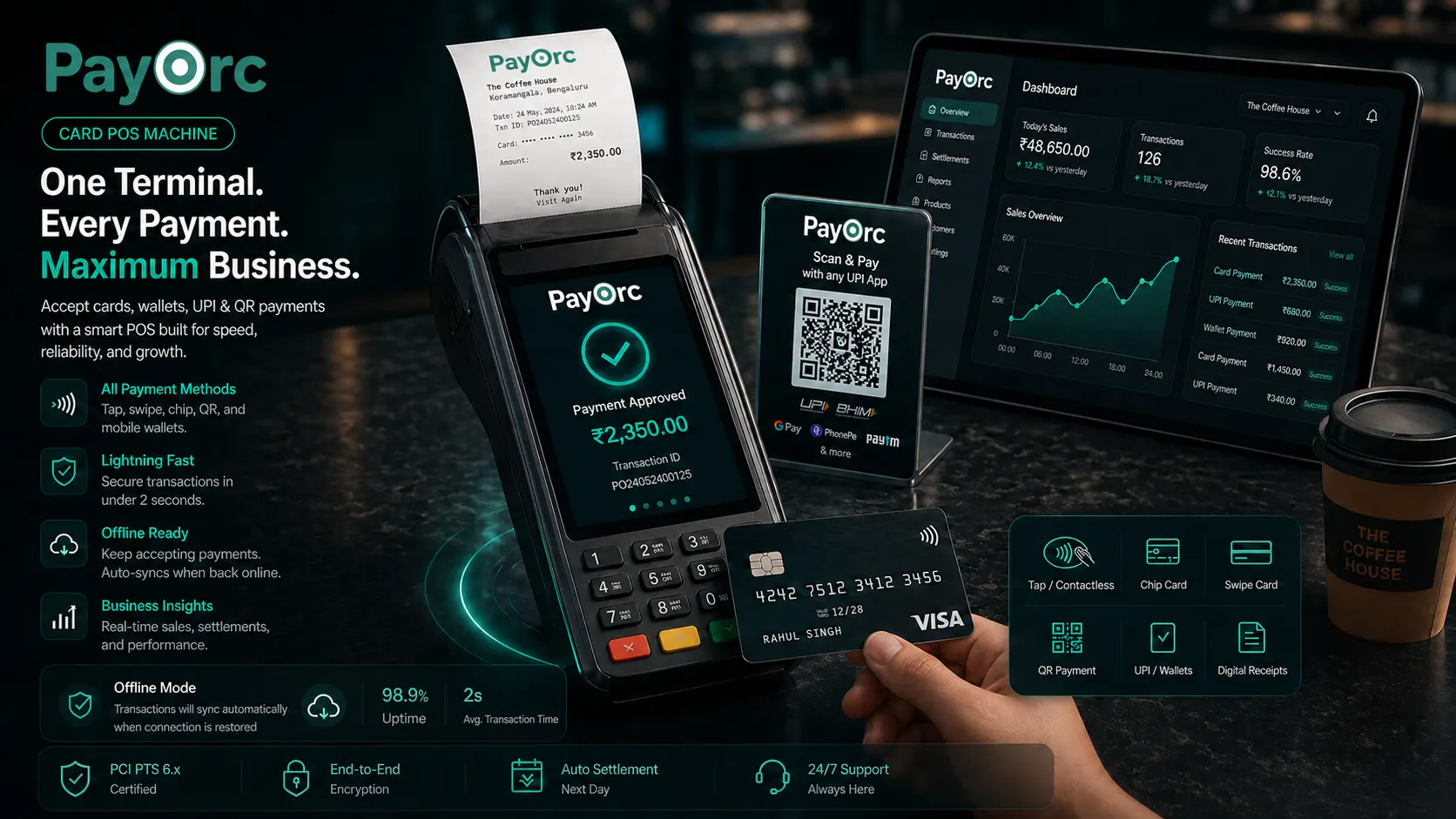
In-Person Payments with PayOrc POS
For merchants operating in India, PayOrc provides the POS technology and orchestration experience in partnership with local PSP, PAPG, PG. The licensed local payment gateway, PSP, or acquiring bank handles merchant approval, payment processing, and settlement. Eligible card tap, UPI QR, and wallet transactions can be presented alongside web and app payments for unified merchant-side visibility and reconciliation.
- Unified online + POS dashboard — view all transactions from web, app, and in-person channels in one place.
- Partner-led routing and reconciliation — POS transactions follow the rules and settlement terms of the approved local provider or acquiring bank.
- Device and method support, including chip & PIN, contactless, UPI QR, and wallets, depends on the selected local partner and merchant approval.
Market context
Payment acceptance in India
India has a method-diverse payment environment built around UPI, RuPay, international cards, net banking, and wallets. A useful checkout should adapt method priority to the customer's device and transaction context while preserving clear status handling when a bank app or provider redirects the user.
Indian payment operations also require careful reconciliation across provider references, UPI identifiers, refunds, chargebacks, and settlement files. PayOrc can normalize provider responses and events so the merchant application works with a consistent payment workflow.
Integration planning
Build a reliable local workflow
Test intent, collect, redirect, timeout, and asynchronous confirmation paths rather than treating every UPI or bank payment as an immediate card-style response. Webhook idempotency and reconciliation are essential because the final status may arrive after the customer leaves checkout.
The Reserve Bank of India (RBI) oversees payment systems. PayOrc acts as a technology service provider to payment gateways, PSPs, and banks; applicable data, onboarding, recurring-payment, processing, and settlement obligations remain under the guidance and responsibility of the merchant's licensed regulated partners.
Regulatory reference
Reserve Bank of India (RBI). Regulatory applicability varies by merchant, provider, activity, and commercial arrangement.
PayOrc operates in India as a technology service provider and payment-orchestration layer, working with locally licensed payment gateways, PSPs, and acquiring banks governed by RBI. PayOrc is not the acquiring bank or regulated payment provider; licensing, merchant approval, payment processing, and fund settlement remain with the applicable regulated partner.
Frequently asked questions
India payment integration FAQ
Can PayOrc support UPI and card payments through one integration?
PayOrc can normalize connected provider workflows for UPI, cards, and other methods. Method availability depends on the merchant's approved provider accounts and production configuration.
Why are webhooks important for Indian payment methods?
UPI, net-banking, and redirected payment flows can complete asynchronously. Signed, idempotent webhooks help the merchant update orders safely when the final provider status arrives.
Who regulates payment systems in India?
The Reserve Bank of India (RBI) regulates payment systems. PayOrc is a technology service provider and orchestration layer, while the merchant's licensed payment gateway, PSP, and acquiring bank handle applicable regulated payment activities and approvals.
Every Payment. Orchestrated.
Route eligible transactions across connected providers using configured rules, with fallback and unified visibility when multiple payment connections are available.
Payment Routing
Manual provider selection
- Slow decision making
- Human error prone
- No optimization
AI-powered smart routing
- Real-time optimization
- +15% auth rates
- Cost reduction
Failed Payments
Lost revenue on failures
- No retry logic
- Customer drop-off
- Manual intervention
Intelligent cascade retries
- Auto-fallback chains
- 40% recovery rate
- Zero manual work
Analytics
Fragmented dashboards
- 5+ different portals
- No unified view
- Manual reporting
Single unified dashboard
- One pane of glass
- Real-time insights
- Instant drill-down
Cost Management
Unoptimized fee structure
- Fixed routing
- Higher processing fees
- No visibility
Dynamic cost optimization
- 20-30% cost savings
- Route to lowest cost
- Full transparency
Built for Scale
Enterprise-grade payment infrastructure that grows with your business in India.
25+
Payment Providers
99.99%
Uptime SLA
150+
Currencies
Provider-led
Settlement